To Get Things Done
I turned 60 a couple of years ago. I hadn’t struggled with starting milestones decades before, but the decade with a 6-handle felt different. It meant I was entering the fourth quarter and there wasn’t going to be over time.
What changed the most was a newfound, palpable, sense of urgency to focus on the things that I said I was going to do but hadn’t. The big things. The things that needed to get done.
One of those things was writing the book.
It was something that many people in my life kept pestering me about (in an encouraging way).
“Kurt, when are you going to write that book?”
“Kurt, how’s that book coming?”
The first problem… I never thought of myself as a writer. I love telling stories, but converting the spoken word – full of facial expressions and animated body language – to the written word is not on my list of gifts. But this was the start of the fourth quarter. If not now, when?
The second question….Why this book?
When we started 410 Bridge in 2006, we knew we wouldn’t be successful without generous support from this side of the bridge. What wasn’t so obvious at the time, but quickly became clear, was that while Western support was essential, it wasn’t enough. If we were really going to make a difference, we needed to change the paradigm of how the West engaged the poor.

If You Really Want to Help is just that. It tells the story of how 410 Bridge came to be and lays out an approach to extreme poverty that doesn’t see the poor and as a set of problems to be solved – a water problem, education problem, economic problem, or health problem. It sees the poor as the solution to their poverty problem.
In this book, I try to convey a foundational principle. When we define poverty as a material problem, our interventions will be solely financial. I find it fascinating that we (this side of the bridge) haven’t learned, or perhaps it’s just easier to ignore, that purely economic interventions do not solve the poverty problem. A better solution, if you really want to help, is to recognize that poverty is in issue of worldview – how people think, the story they tell themselves to be true.
The Story of Us
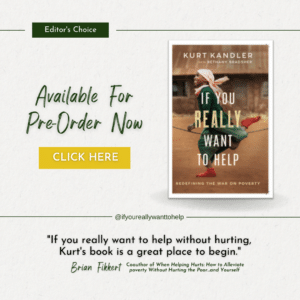
If You Really Want to Help describes our origin story, strategy, methods, successes and yes…. the many missteps along the way. It shares stories of real people who have been impacted by 410 Bridge’s work around the world. Impact that is measured against outcomes and is indigenously sustainable.
In the end, if we’re really going to help the poor, it starts with correctly defining the problem. And if we’re really going to help the poor shift their worldview from whatever it is today, to a worldview that helps them thrive and live an abundant life, we must start by changing how this side of the bridge engages.
In his book – If You Really Want to Help – Kurt lays out a fresh blueprint for redefining the war on poverty, how to win it, and how we fight the battle together. His book will be released February 28, 2023 and is available here.